Showing posts with label Semipalmated Plover. Show all posts

Saturday, May 7, 2016

Clatsop County Shorebird Extravaganza


This was the weekend I set aside to look for shorebirds at the coast.  I headed to the ocean beaches in Clatsop County.  As they were a few weeks before, when I arrived at low tide at Gearhart the beaches were packed with clammers.


Not my favorite way to bird, driving around and in between parked cars and people.

I tried to scan the large flocks of Western Sandpiper for rarities.


None found except I spotted one lone Baird's Sandpiper on the back side of a flock, no photo.  I drove the 4.7 miles from 10th St to the Sunset exit. I got tired of the crowds and dodging cars, I bailed despite all the birds.  I estimated 10,000 Westerns and 3000 Dunlin,  One Western every yard over that distance would be 8,300 birds.  I am probably  low in my numbers.

Whimbrel were also scattered about the beach.


After a quick stop at Parking Lot B and C to see if any beaches were empty of clammers, they were not, I headed to the Airport Ponds.  They had some warblers singing and Savannah Sparrows out as well.  Savannah Sparrows are one of my favorite sparrows: if you see them , you are in a good spot to bird.


I checked out a few spots around the airport with no luck on shorebirds.  I decided to head back to Parking Lot C and just wait for the tide to come up and watch the birds stream off the beach.  

When I got to the jetty, I could see groups of birds on the beach.  Things were looking up.


Red Knots were on the beach along with flocks of Dunlin and Western Sandpipers.


Four Red Knots and a Dunlin.


Cape May or Clatsop County?  Three Red Knots, two Black-bellied Plover and a Ruddy Turnstone.


I decided this was a Short-billed Dowitcher, no hump and even flank marks.  I think I heard it call.


Nice group shot. Whimbrel, Ruddy Turnstone, Black-bellied Plover and Dunlin.


Sanderlings prefer feeding in the waves, rather than the sand.  But not as far out as phalarope, which is one shorebird I did not see today.


Birds were flying off the beach up over the jetty and on northward.

Four species flying by. I think the Sanderling is a first-spring bird.  Looks like it is still in basic plumage.  I was wondering if it molted yet still maintained a basic aspect. I could not relocate it,


Huck needed a break after standing patiently while I watched birds. I went to an empty stretch and let him blow-off steam.


When he is done he goes up to the edge of the dune and drops his stick.  I think he is hiding it from other dogs.


After a few cars came and went, most of the birds had left the ocean beach.  I walked out to the River Beach and relocated the flocks.

Three different views of Red Knots.  The gray rump is a good field mark.


My favorite Red Knot photo of the day.  Stocky bird with broad-based wings.


I was scanning the peeps looking for a stint when I saw this plover, it was obviously smaller than the Black-bellied Plover nearby.


Bill looked long for an American and body was not elongated looking due to the longer wings on American. White extending down the sides.  I decided it was a Pacific Golden-Plover.


White under-tail coverts. I do not see long wings.


I had to smile when it ignored the aggression from the much larger Black-bellied.


I always hope to spot a Royal Tern that was dragged north with the Caspian Terns in early spring, no luck today.


All black shorebird, I was thinking Spotted Redshank, but went with Turkey Vulture instead :) 


I did not ask what was on the menu, I assumed sea lion.


Done with the river, I cut back over to my car, Whimbrel were arriving at the shorebird flats for high tide.


My total shorebird count for the beaches around Parking Lot C and the flats totaled 15  16 for the day:

Least Sandpiper (just two)
Western Sandpiper
Baird's Sandpiper (one)
Sanderling
Dunlin
Red Knot
Short-billed Dowitcher  (plus a few dowitcher flocks, tried for Long-billed)
Whimbrel
Marbled Godwit (one)
Wandering Tattler (one)
Greater Yellowlegs
Semipalmated Plover
Black-bellied Plover
Pacific Golden-Plover (one)
Wilson Snipe (one)
Ruddy Turnstone (thanks to Marcia for noting I forgot the Ruddy when first posted)

Great day at the beach.

Thanks for visiting.


Sunday, January 10, 2016

Netarts Spit at Cape Lookout State Park

I returned today (1/10/15) for what is turning out to be an annual birding trip to Cape Lookout State Park , the beach area.  Last year's report is here.

Today was warm with lots of sunshine, a strong easterly wind soon died down.

I was a bit concerned about a rising tide.  I did not want to get nailed by a wave coming up a narrow beach with all these logs strewn about.  I made it to the north end with no trouble; by the time I was done checking out the bay the tide had turned and was ebbing for my walk back down south.


Lots of Surf Scoters were doing what Surf Scoters do.


As the tide was rising on my northerly walk all I saw on the beach were Sanderlings and Dunlins.


Their bill lengths do vary a bit.


Sanderling and Dunlins taking a nap.


I wanted to explore the interior in hopes of some passerines and that one rare bird that would make the day. This large bog was full of Mallard, Northern Pintail and Northern Shoveler.


Some Mallard even from this far away saw me and flushed off the bog, so I did not stay around too long.  When I whistled like a Pygmy-Owl even more flushed, what the heck was that about.


I finally walked the 5 miles to the tip.  A small flock of gulls were on the bay side.   I figured this was a first-year Thayer's.  Nicely checkered pattern.


Mew Gull.


Same bird. When it flew in, the underwing was more like a Thayer's than a Herring Gull. It seems too bulky and short-winged for a Thayer's.  I know some Herring can have less black on the underwing.  Apical spots seem in between. I decided on Herring due to structure of body and bill.


On the walk back south  the tide was just turning toward ebb.  A Black-bellied Plover was on the beach.


It was hanging out with a Semipalmated Plover.


With high tide came lots of Least Sandpipers hiding in the beach debris..  I looked at every peep, all looked Least to me.


At a few points along the beach you can go to a dune and look over a narrow spot into the bay.  Northern Pintail were hanging out on the marsh grass.


One of the few passerines spotted..


Song Sparrows were just about the only passerines willing to show themselves.


Netarts Spit (Cape Lookout St Pk), Tillamook, Oregon, US
Jan 10, 2016 8:15 AM - 3:00 PM
Protocol: Traveling
10.5 mile(s)
Comments:     sunny, gusty wind form east in morning then light breezes
35 species (+1 other taxa)

American Wigeon  7
Mallard  150
Northern Shoveler  10
Northern Pintail  120
Surf Scoter  45
Bufflehead  6
Western Grebe  1
Northern Harrier  1
Cooper's Hawk  1
Bald Eagle  3
Red-tailed Hawk  1
Black-bellied Plover  1
Semipalmated Plover  1
Sanderling  125
Dunlin  75
Least Sandpiper  200     many on beach, have photos
Mew Gull  4
Western Gull  12
California Gull  2
Herring Gull  1 
Thayer's Gull  1
Western x Glaucous-winged Gull (hybrid)  14
Common Raven  3
Black-capped Chickadee  2
Marsh Wren  3
Ruby-crowned Kinglet  2
Wrentit  1
Hermit Thrush  2
American Robin  4
Varied Thrush  2
European Starling  10
Yellow-rumped Warbler  3
Fox Sparrow  2
Dark-eyed Junco  4
White-crowned Sparrow  5
Song Sparrow  12
Spotted Towhee  1


Huck enjoyed the company of a gal pal named Tess.  She is a youngster that never tired, Huck and I enjoyed having her along.


Saturday, August 1, 2015

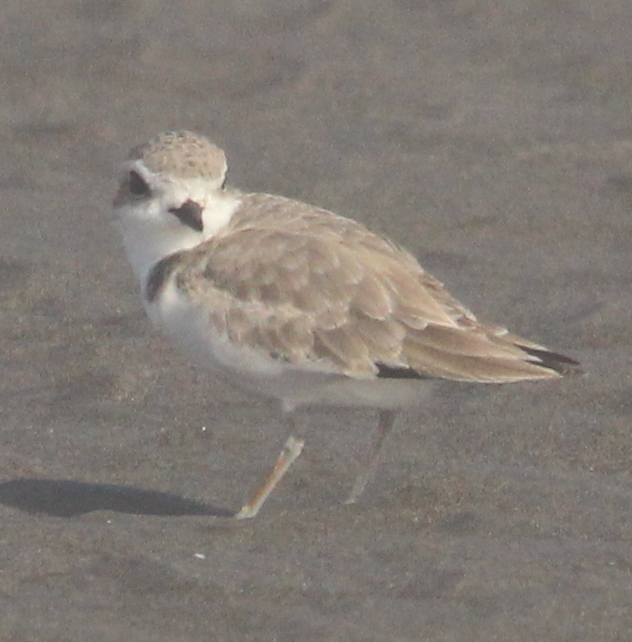
Snowy Plover in Clatsop County

Once again I wandered down to Clatsop County to escape the heat of Portland and to hunt for shorebirds.  It was foggy on the beach but I found the usual Western Sandpipers (mainly juvenile), Least Sandpipers, Sanderlings and Semipalmated Plovers.  I did see two Snowy Plover, my first for the Clatsop County beaches.  I thought I would post the photos for those that research and protect these little birds.

If you want to see another "beach" plover, check out my previous blog I posted at end of July "Where in the World".

I think the first three photos are of a hatch-year.  Fresh feathers and buff edges to coverts.


I think the next two are photos of adult female. Seems to have worn feathers and lack buff edging. Sexing these birds this time of year based on plumage is not always reliable.


Back to a hatch-year.  Not sure if this is same hatch-year as the bird above.  If not, then I saw three plover.


The adult with the hatch-year.


The juvenile Western Sandpipers were on the beach in force.  Clean neat feathers clearly show this to be a juvenile.  The rufous-edged upper scapulars are an easy spot as well.


The crouched down eating style of a Least Sandpiper.


After finding zilch on the river beach, I went to Parking Lot D to see if I could find any odd terns, tons of Caspian, lots of California Gulls and one Black-bellied Plover.  A flock of peeps flew in and landed across the water.  Before going on down blog, can you spot the Baird's?


This rather pale plover ( hatch-year Semipalmated) looked very long-winged to me. I could not get a real good look at it except with this photo. 


Crazy bright rufous on this Least.


This one looked larger than the rest and I could just make out the long wing tips past the tertials. Baird's Sandpiper. 


I deleted a section of my previous blog about feather tracts, I decided it was rather sloppy.  I hope to get photos of sandpipers with different feather tracts exposed on the wing.   Here are some wing shots I'll just throw out there.  See if you can figure out the tracts.


I decided Black Turnstones are a nice bird to show how the scapulars flip up to cover the wing. They are always stretching their wings.


I think this one is missing some primary coverts.


One of these days I'll repost these with the tracts correctly marked. My problem is figuring out where the lower scapulars end and the greater coverts begin.  And if the wing is messy with molt it is even tougher.


Heermann's Gulls are gradually losing their white heads.  


Thanks for visiting.