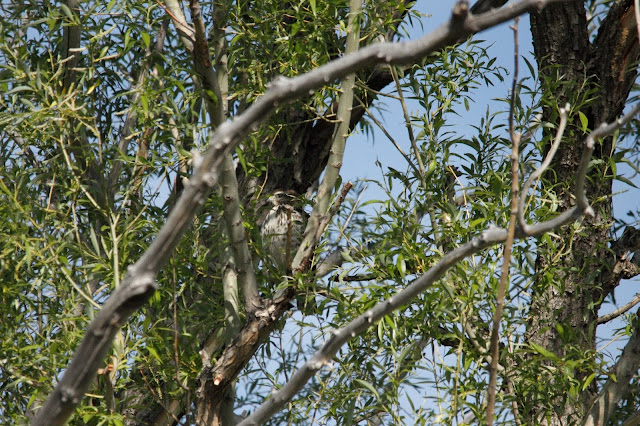
A Western Flycatcher started singing way before sunup. Interesting they are always the first bird you hear in the early dawn. I packed up and headed down to Lake Abert.
A few views of the lake. I thought I scanned the white beach areas carefully, still I missed seeing Snowy Plover.


A badger came out on the flats, made sure all the avocet could fly away, then went for a swim.

The screaming American Avocet was convinced it was the reason the badger left after its swim.

Counting American Avocets was tough with all the reflections. Count all the birds and divide by two?

Even from a great distance, the crouched look of Least Sandpipers is apparent.

All I saw in this flock were Western Sandpipers.

A few Willet were mixed in to the avocets. The very pale gull is a Ring-billed. The others are California.

A large flock of Wilson's Phalarope were along the lake.

Here are my numbers from Saturday morning.
Lake Abert, Lake, Oregon, US
Jul 16, 2016 7:30 AM - 10:40 AMProtocol: Traveling
16.0 mile(s)
Comments: clear no wind, lake was calm
32 species (+3 other taxa)
Canada Goose 150
Mallard 5
duck sp. 50 distant
Chukar 3
Pied-billed Grebe 4
Eared Grebe 8
Double-crested Cormorant 12
Great Egret 4
White-faced Ibis 41
Red-tailed Hawk 1
Virginia Rail 2
Black-necked Stilt 187
American Avocet 3900
Willet 23
Least Sandpiper 39
Western Sandpiper 190
Wilson's Phalarope 230
Ring-billed Gull 47
California Gull 139
Rufous Hummingbird 1
Western Wood-Pewee 4
Say's Phoebe 1
Ash-throated Flycatcher 1
Loggerhead Shrike 4
Common Raven 3
Violet-green Swallow 23
Cliff Swallow 35
swallow sp. 100
Rock Wren 13
Brewer's Sparrow 13
Black-throated Sparrow 18
Lark Sparrow 2
Sagebrush Sparrow 2
Brewer's Blackbird 270
blackbird sp. 20
At the northern end of the lake is a county road right past the power lines. Turn left ( heading north) and go for a few miles. You will find The Oasis.

A family of Loggerhead Shrike were in the area. Orioles, swallows, Brewer's Blackbirds, and Red-tailed Hawk were here as well.

I spent the afternoon down in Lakeview checking out some of the birding spots in town and getting gas. Goose Lake St Park was quiet as was Bullard Canyon, still good to see the area and the sewage ponds had good views of Leasts, Wilson Phalarope, and American Avocet.
With a full tank of gas, I headed up to Paisley, got a burger to go at The Homestead (great spot) and headed down Mill St to access FR 3315. Sage Sparrows and California Scrub-Jays were along the first leg of the road up from Paisley.
The view of Paisley from the road.

FR 3315 is a nice road. Only a few stretches of my entire drive up there had small rocks that made me nervous for my tires.


My second badger of the trip was along FR 28 (paved). He trotted off into the woods.

I pitched my tent at Lee Thomas CG. This rock structure was part of the CG. I wondered who Lee Thomas was, he was an architect that designed, among other things, the MU at Oregon State, a beautiful building. I assume the same Lee.

Birds seen at Lee Thomas CG:
Fremont-Winema NF--Lee Thomas Campground, Lake, Oregon, US
Jul 17, 2016 4:00 AM - 5:30 AMProtocol: Stationary
Comments: camped
20 species (+1 other taxa)
duck sp. 2
Great Blue Heron 1
Osprey 1
Red-tailed Hawk 2
Sandhill Crane 2
Common Nighthawk 4
Common Poorwill 2
Red-breasted Sapsucker 1
Northern Flicker (Red-shafted) 2
Western Wood-Pewee 3
Dusky Flycatcher 2
Warbling Vireo 1
Common Raven 2
Mountain Chickadee 3
Brown Creeper 2
House Wren 2
American Robin 4
Yellow-rumped Warbler 5
Dark-eyed Junco 3
Lazuli Bunting 2
Cassin's Finch 3
Sunday morning I bagged my plans to bird in the Gearhart WIlderness, I calculated the time needed and decided it was better spent simply birding my way back to Paisley so I could visit Summer Lake WMA before heading home.
The forest is well marked with road signs and the roads are in good shape.

At one of my first stops on the way back to Paisley was this woodpecker. It looked like it had its black shield. It has a small white chin, no red on breast. When I first saw it , I thought it had an all red head. But when I got close I could see it had black as well. Female Red-naped Sapsucker. Either Red-naped or Red-breasted were at all my stops.


This was the meadow with the above sapsucker. It is along FR 3411 where the road hits FR 28. It was full of singing birds. Lincoln Sparrow, Yellow Warbler, Common Yellow-throat and White-crowned Sparrow.


The subspecies of White-crowned was oriantha. The "Mountain" White-crowned. I have also seen them on The Steens. The upper back is gray with brown streaks. The lores are black. Elevation of this meadow is 6700 feet.


Very short video of its call note. It chips in the very first few seconds, loud and harsh.
Sorry for the drifting camera on this, very short video of its song. I posted similar video of one singing on The Steens in June of 2015.
Birds seen at this meadow:
Meadow a x of 3411 and 28, Lake, Oregon, US
Jul 17, 2016 7:00 AM - 7:45 AMProtocol: Stationary
Comments: temp 40, sunny no wind
20 species (+1 other taxa)
Red-naped Sapsucker 1
Red-breasted Sapsucker 2
Western Wood-Pewee 3
Dusky Flycatcher 2
Empidonax sp. 2
Warbling Vireo 1
Common Raven 2
Mountain Chickadee 66
Red-breasted Nuthatch 5
Brown Creeper 3
House Wren 3
Mountain Bluebird 7
American Robin 2
Common Yellowthroat 5
Yellow Warbler 3
Chipping Sparrow 3
Dark-eyed Junco 6
White-crowned Sparrow (oriantha) 5
Lincoln's Sparrow 4
Western Tanager 1
Cassin's Finch 3
After having a great time watching and listening to all birds I moved on down road, stopping and birding a few side roads. This is one long-billed Hairy Woodpecker.

Another checklist from a stop along the road:
clearcut down the side road, Lake, Oregon, US
Jul 17, 2016 9:15 AM - 9:45 AMProtocol: Traveling
1.0 mile(s)
Comments: partly cloudy, clouds came in wind kicked up just a bit
16 species (+1 other taxa)
Western Screech-Owl 1
Hairy Woodpecker 1
Western Wood-Pewee 3
Dusky Flycatcher 2
Empidonax sp. 2
Steller's Jay 2
Clark's Nutcracker 1
Mountain Chickadee 7
Red-breasted Nuthatch 6
Brown Creeper 4
Hermit Thrush 2
American Robin 3
Yellow-rumped Warbler 2
Hermit Warbler 1 While tracking mob of birds driving owl out of area, no visual but from maybe ten trees away heard Hermit Warbler song very similar to song in Cascades. First part two syllable, second part rising bellish quality. Realize some songs could overlap with Townsend's but I do not think this is one of them?
Chipping Sparrow 2
Dark-eyed Junco 3
Western Tanager 2
HY Clark's Nutcracker. It was dull brown colored compared to bright pattern of an adult.

Downhill from the nutcrackers was a meadow, I birded it Saturday and Sunday. Oddly enough out in the middle of the woods was an old outhouse. I figure hunters use the meadow as a large basecamp and someone decided to bring a luxury of home to the outdoors.

This Hatch-year (HY) Mule Deer was at the meadow on Saturday.

Part of forest birding is knowing when you hear a bird and when you hear a chipmunk. This little one had a higher pitched "brake squeal" of a call than the ones I hear in the Cascades.

One of the logging roads I went down led me to this view of Summer Lake. Hwy 31 would run on the left side somewhere.

I think this is Mountain Mahogany. There was a ridge of juniper and this mahogany on the east side of the forest, right before you drop back down to the valley (6 miles from Paisley, one mile into Fremont NF.). I listened and looked for Virginia's Warblers, not much of an effort but you never know. I was also hoping to find Juniper Titmouse in the juniper stands on the east slopes of the mountains, no luck.

Now some random bird shots .
HY Killdeer at Lakeview Sewage Ponds.

HY Black-necked Stilt have a brown tinge to the feathers and lack the bright legs of an adult.


I could not decide if this was a molting adult avocet or a HY bird losing its brown tinge.


Least Sandpiper at the Lakeview Sewage Ponds.

White ground color,stout bill, brown checkers. HY Ring-billed Gull. The bill is usually pink at base.

I was trying to get a good photo of a HY White-faced Ibis. With my binoculars I saw a red eye. They get their red eye later in the year, so this is at least a second year bird.

Pelicans at Summer Lake mid-day Sunday. I saw a flock of about 160 Long-billed Dowitchers and a few Greater Yellowlegs, otherwise quiet on the loop drive.

I urge birders to wander the area up behind Paisley and Summer Lake in the Fremont National Forest, beautiful spot to bird. As an afterthought, it might be better to bird the Fremont by entering up at Silver Lake and simply follow FR 28 down past East Bay CG and then take FR 3315 out to Paisley. The White-crowned meadow is very close to the FR 28-FR 3315 interchange.
Thanks for the visit.