Showing posts with label Osprey. Show all posts

Saturday, April 2, 2016

Northern Rough-winged Swallows at Sundial Is and the rest of March


In the spring Northern Rough-winged Swallows and female first-spring Tree Swallows can be an identification challenge.  The Tree Swallows go through a molt in their first fall (pre-formative molt)  they then wear into a plumage aspect the next spring that can look much like a Northern Rough-winged Swallow (this plumage is also confused for Bank Swallows).  Interestingly there might be an advantage to this unique plumage.  The first-spring females can be recognized as females by aggressive territorial males and as subordinates by the older females (Stutchbury and Robertson).

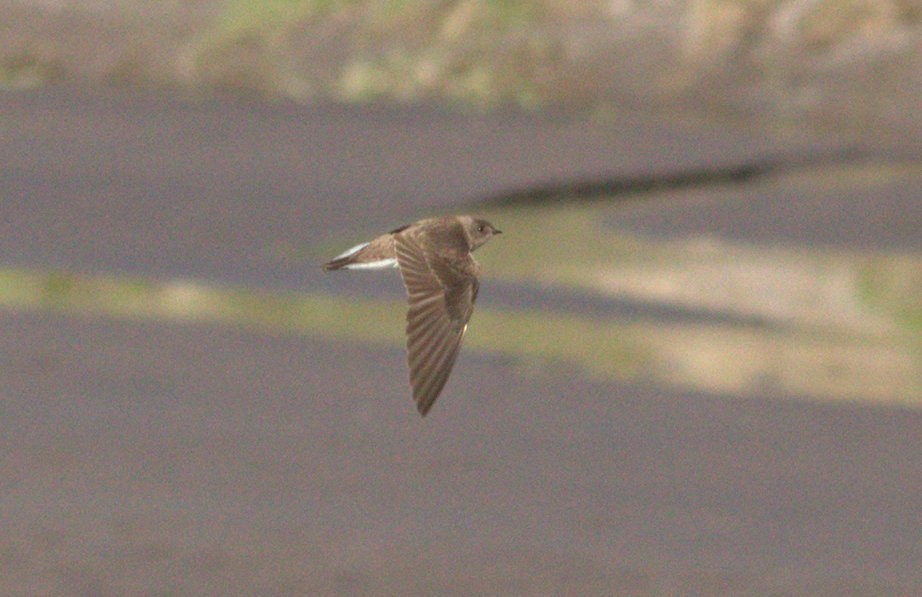
I found a small flock of Northern Rough-winged Swallows on Sundial Island today.  You can see the birds lack the sharply demarcated throat of a Tree Swallow.  The brown smudge on the throat contrasts with the nice white undertail coverts. They lack the flank patches.  They fly with a slower more deliberate wing stroke and their call sounds are short, rough prrts.  

In case you need to know where Sundial Is is:  Sundial Island


I was wondering if this Northern Rough-winged Swallow was doing a display.  It was showing its white undertail coverts.  There were 5 swallows in area, I think only one was doing the display. I have thought I have seen white on the topside on these birds before but was finally able to get a photo of what I was seeing. 


If these are displays, it looks like they squeeze their tail closed and push the coverts out.


Other things out at Sundial:

Bushtit and the nest.


I called this a Cooper's Hawk.


My ebird list from today:

Sundial  Island, Multnomah, Oregon, US
Apr 2, 2016 8:15 AM - 1:45 PM
Protocol: Traveling
5.7 mile(s)
Comments:     sunny, light west wind
45 species (+3 other taxa)

Cackling Goose  12
Canada Goose  7
Wood Duck  5
American Wigeon  1
Mallard  6
Greater Scaup  12
Lesser Scaup  12
Greater/Lesser Scaup  6
Bufflehead  4
Common Merganser  4
Double-crested Cormorant  2
Great Blue Heron  3
Turkey Vulture  1
Sharp-shinned Hawk  1
Cooper's Hawk  1
Bald Eagle  5
Red-tailed Hawk  3
Killdeer  3
Greater Yellowlegs  2
Western x Glaucous-winged Gull (hybrid)  1
gull sp.  2
Mourning Dove  4
Great Horned Owl  1
Anna's Hummingbird  1
Rufous Hummingbird  1
Downy Woodpecker  4
Northern Flicker  11
Pileated Woodpecker  1
Western Scrub-Jay  0
American Crow  4
Northern Rough-winged Swallow  5
Tree Swallow  50
Black-capped Chickadee  20
Bushtit  6
Brown Creeper  4
Bewick's Wren  5
Ruby-crowned Kinglet  6
American Robin  40
European Starling  5
Orange-crowned Warbler  2
Common Yellowthroat  19
Yellow-rumped Warbler  3
Dark-eyed Junco  7
White-crowned Sparrow  15
Song Sparrow  5
Spotted Towhee  11
Red-winged Blackbird  15
Brown-headed Cowbird  2
House Finch  5

The past few weeks I have been hitting Sauvie Island a few times, the Sandy River Delta, Tillamook and a trip to Wasco County to search for possible migrant traps for the spring.  Not much exciting but fun experiences nonetheless.

Red-necked Grebe at Tillamook.


 Osprey enjoying the flower garden out on the porch.


Violet-green Swallow at the Sandy River. Very different shape and flight style from the Northern Rough-winged Swallow.


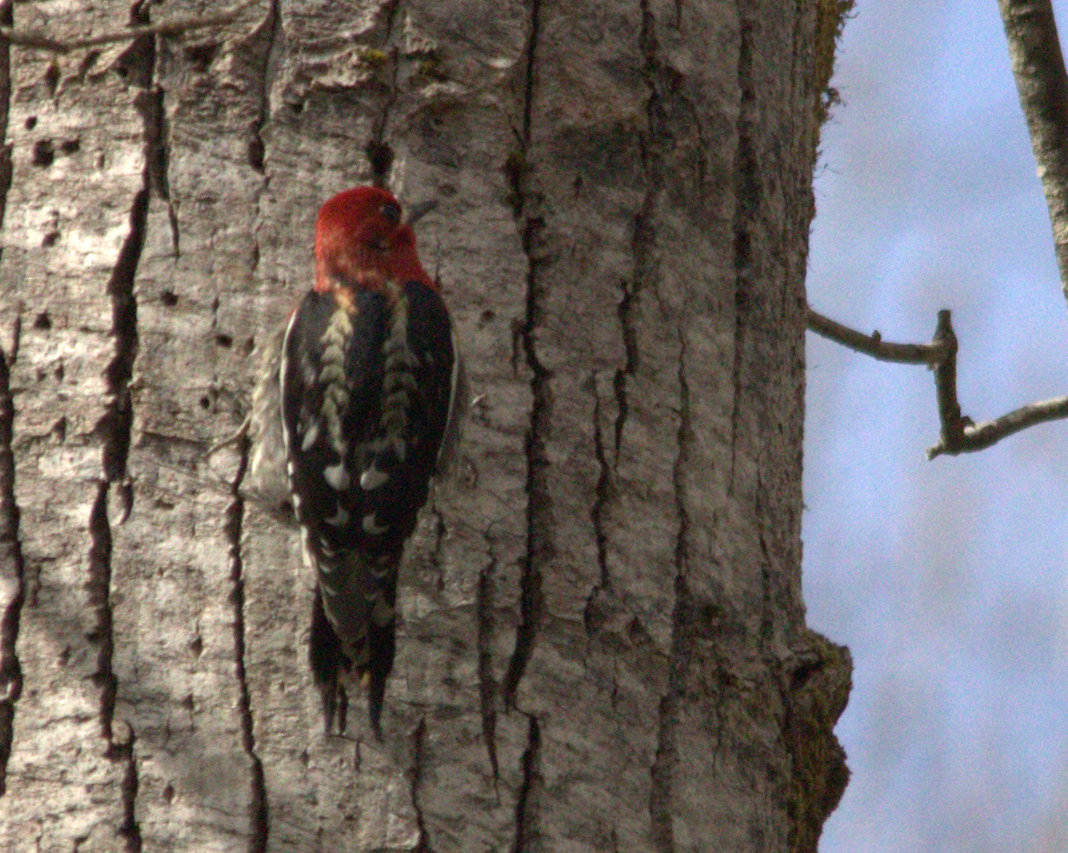
There has been a discussion on OBOL about hybrid sapsuckers.  It was mentioned that the southern race of Red-breasted has a color pattern underneath the red on the neck that when exposed through wear can look like a Red-naped, thus encouraging false hybrid assumptions.  I could not find anything in the literature regarding this on the northern race of Red-breasted, the beast expected in northern Oregon. I decided to look for evidence of this pattern on the northern race. This one seems to show the underlying black mentioned.


Here is the section of the paper that mentions the issue:

"The plumages of the two forms are well described in the literature (Howell 1952: 240-245, Devillets 1970, Dunn 1978), and only a brief summary is given here. The differing head patterns of daggetti and nuchalis are based simply on an interplay between varying proportions of carotenoid and melanin pigments. When carotenoid pigments dominate the barbs of the head feathers, especially their tips, the relative amount of melanin present is reduced and the daggetti phenotype is seen. Conversely, when black melanin pigment is packed into the feathers of the breast and those of the sites of the black head stripes, the nuchalis phenotype emerges. Although only the feathers of the sites of the white head stripes and those of the throat and crown never have black pigment, all sites can have red pigment, especially in the barb tips, except for small lateral stripes at the base of the upper mandible that always remain whitish. However, even in the reddest individuals of daggetti, a reduced quantity of melanin pigment still is present as a narrow dark band in the middle and basal portions of the feathers of the head and breast, forming an underlying "shadow" that is reminiscent of the melanistic breast band, cheek patch, and head stripes seen so vividly in nuchalis. This is easily demonstrated by clipping the tips off the barbs of feathers in the relevant areas of the head and breast. This point is of special significance because progressive wear of the head and breast feathers during the nesting season, caused primarily in adults when they squeeze through the nest opening, exposes increasing amounts of blackish or dusky color and causes normal daggetti to be identified incorrectly as hybrids. The presumption of all earlier authors that hybridization between daggetti and nuchalis is very common has been based on the routine underestimate of the amount of black normally hidden below the red barb tips of the head and breast feathers in daggetti. This problem is perpetuated in even the most recent field guides (National Geographic Society 1983: 269)."


Thanks for the visit and hope to share some more exciting trips soon.  The roads into the east side of Mt Hood Nat Forest just opened a few days ago and another pelagic on the 30th.


Literature cited:


Johnson, N.K., and C.B. Johnson. 1985. Speciation in sapsuckers (Sphyrapicus): II. Sympatry, hybridization, and mate preference in S. ruber daggetti and S. nuchalis. Auk 102:1–15

Stutchbury, B.J., and R.J. Robertson. 1987. Signaling subordinate and female status: two hypotheses for the adaptive significance of subadult plumage in Tree Swallows. Auk 104:717–723

Friday, July 31, 2015

Where in the World

Lets see if you can figure out where I was.

I went back to my home state last week for a family reunion.  We converged on the family's historical summer hangout.


This lighthouse appears on the state's license plate.  The area marked off by posts and rope is for a Piping Plover breeding site.  A biologist watching the birds told me there are 92 breeding pairs left along this state's many barrier island beaches.  My routine on this trip (and as a kid) was to get up early in the  morning and head to the beach for a refreshing dip in the 72ish degree water.  I then walked up to the south jetty to see what birds I could find.  Great Black-backed Gulls on the beach always seemed to be right on the edge of the protected area. If one got too close, a parent Piping Plover would come over and stand next to the gull.  The young Piping Plover face many dangers, gulls, foxes, mink, raccoon all are in area.


Adult Piping Plover.  In their rather worn plumage I could not tell male from female.  The biologist knew by the colored leg bands.  They thought the male had left the area, I found him still on the site.  That was great news to the folks watching them, I can't recall if this was the male or not.  I think it was the female.


One of the three Piping Plover chicks on beach.


Laughing Gull.


Ruddy Turnstone were easy to find.


A flock of about 6 American Oystercatchers were on the beach.


I could not tell if this was a juvenile Forster's Tern or Common Tern.  The dark carpal bar, look of an all dark cap, and dark wings had me go with Common.


A variety of hudsonia, they bloom yellow earlier in the year.


This Willet was silent, so I could not determine if it was a Western Willet for sure or not.  It looked large, long billed and slender.


Least Sandpiper


The next twelve photos are all of Semipalmated Sandpipers, a very common bird this past week for me. However a hard bird to study on the west coast.


Least in the background.


On my last day of the trip I visited the second most famous birding area in the state.  My favorite birding spot of all time.  Below is a photo of the  loop road and one of its iconic towers.  It is wise to stay near your car on this loop , the Greenhead Flies are just plain nasty and I swear it feels as if they take chunks of skin when they bite.


When I was a kid, this city across the bay was a bit rundown and best known for it's streets being used in a board game. For the last few decades gambling has brought in big hotels and not much else to this coastal city. 


This Willet seems to have the shorter bill more common to the Eastern Willet.


Lots of terns to study. Most are Forster's.


This one flew when I got out of the car to get a closer look, Gull-billed Tern.


Hibiscus in the background, Glossy Ibis in the middle.


Osprey are doing well here,  I did not count the number of nests I saw and successful young birds being raised , but I would guess I saw more than 20 Osprey.


Fiddler Crab.


Family of Clapper Rail, gray edges of brown back feathers.


Black Skimmers and Laughing Gulls chilling on the mud flats.


So what two spots did I visit?  Thanks for visiting !


Saturday, April 4, 2015

The New Fernhill

I had heard of all the changes at Fernhill Wetlands but had yet to visit the site since the trails had reopened.  I took a drive out there today after wandering around a cloudy and foggy Mt Tabor earlier in the morning.

The Fernhill site is owned by Clean Water Services.  They are trying to improve the water treatment site.  The idea is to use a natural process to clean and cool waste water before it enters the Tualatin River.   It is called a Natural Treatment System (NTS).  Their site is here

For directions on how to get to Fernhill, check out the Oregon Birding Trails Tualatin Loop.

Below is a view south from the parking lot which is located at the northern end of the complex. The phone poles along the right side are on Fern Hill Road.


Next is shot from same spot looking to the east.


This little Killdeer was not pleased with me passing by its nesting area along the trail.  With the stronger black in the face and the bright red orbital ring, I think this is a male. Females would have less contrasting black and more of an orange-red orbital ring


I went counter-clockwise around the site, so down Fern Hill Road first. This picture is of the next pond down the path. I am standing in the small observation deck.  All the ponds are set up in a similar fashion.  They did leave one flooded, the one over in the NE corner.  They will use that water to flood these other ponds every few weeks or so and then let them dry out. This is to get the vegetation off to a good start.


I was happy to see so many American Pipits in the muddy areas. I scanned all that I could, no oddballs.


A beautiful light gray Peregrine Falcon zoomed over the flats, it scared all the pipits up into the air.  A flock of Least Sandpipers took flight and then dove for cover in the mud.  Least Sandpipers can vanish in a mud flat if they want to.  How many can you find?


7
I have now crossed the area on the lower dike.  I am now looking north toward the parking lot. In front of me is the lake they will use to flood the other areas.


These Cacklers were a enjoying a lunch of grass along the lake, until I tried to slip by on the trail.


A  Song Sparrow is nice bird to enjoy when it is sitting out in the sun.


Which three North American warblers sport a bright yellow rump?


Yellow-rumped, Magnolia and Cape May


Dabbler Marsh is much the same as always, as is the area on the east side of the site.  I did hear an Indigo Bunting singing down the trail. I took off on a run to get a picture.  I stopped after a few steps, I realized I had just been fooled by a Lesser Goldfinch.


Which bird is this?  Long thin wings, held in a M shape.


Osprey.

A view looking south with the sun out.


Up behind the restrooms you have access to two small ponds.  They are fenced off but it looks like a trail goes down the south side.  Below is a shot looking east at the two ponds.


There were 27 Greater Yellowlegs and two Green-winged Teal on the ponds.


Greater Yellowlegs look larger headed than Lesser, they have more barring on the flanks in alternate plumage and their bills are thicker looking. And at the right angle they look knobby kneed.


Birds seen inside the NTS boundary (the new mudflats):

Snow Goose  1
Cackling Goose  1000
Canada Goose  15
Gadwall  6
American Wigeon  4
Mallard  11
Green-winged Teal  21
Bufflehead  3
Great Blue Heron  2
Turkey Vulture  1
Osprey  1
Killdeer  6
Least Sandpiper  20
Belted Kingfisher  2
Peregrine Falcon  1
Tree Swallow  75
Violet-green Swallow  15
Barn Swallow  5
Cliff Swallow  3
American Pipit  40
Song Sparrow  3
Red-winged Blackbird  4
Brewer's Blackbird  6
House Finch  4

Birds seen outside the NTS (everything else that was not changed up to middle of dikes):

Cackling Goose  1100
Canada Goose  25
Gadwall  8
American Wigeon  4
Mallard  7
Cinnamon Teal  4
Northern Shoveler  8
Northern Pintail  6
Green-winged Teal  25
Canvasback  5
Bufflehead  3
Common Merganser  3
Ruddy Duck  1
Pied-billed Grebe  1
Great Blue Heron  2
Great Egret  1
Turkey Vulture  1
American Coot  25
Killdeer  2
Greater Yellowlegs  27
Mourning Dove  2
Anna's Hummingbird  3
Downy Woodpecker  1
Northern Flicker  2
Western Scrub-Jay  3
American Crow  1
Tree Swallow  20
Violet-green Swallow  5
Black-capped Chickadee  4
Bewick's Wren  2
Ruby-crowned Kinglet  1
American Robin  6
European Starling  11
Orange-crowned Warbler  2
Common Yellowthroat  1
Yellow-rumped Warbler  9
Fox Sparrow  2
Song Sparrow  14
Golden-crowned Sparrow  6
Dark-eyed Junco  2
Red-winged Blackbird  7
Brewer's Blackbird  1
Brown-headed Cowbird  2
House Finch  7

I am looking forward to see how this area develops.  Thanks for visiting.


Yellow-rumped, Magnolia, Cape May