Showing posts with label Hairy Woodpecker. Show all posts

Sunday, January 24, 2016

Sundial Island at the Sandy River


I have been trying to get to Sundial Island all winter to do a bird survey, the weather finally cooperated today the 24th of January.

For some more information I posted last week about this area and some excerpts from Lewis and Clark's journals try this :  Sandy River

I started off from Camas at 8:15, it is a quick 20 minute paddle across the Columbia. Huck agreed to go along as bow ballast.  The keen observer will note I am paddling the canoe backwards.  A trick when paddling alone is to do just that. It places you closer to the center of the boat, helpful in wind and current.

I hope to visit this island two times per season.  I was disappointed in the number of birds seen, perhaps a slow day.  I wonder if the winds that are common this far up the river keep bird numbers down. There are however lots of great habitat spots. I found only one flock of juncos.  Juncos were a bird I was expecting to see in larger numbers.  I also expected to find some Savannah Sparrows. 


A look upriver from Camas.


And downriver as well.  Lewis and Clark saw huge numbers of geese, swan and ducks here.


The island looked much like it did when it was connected to the mainland.  Except the trails are gradually being overgrown, a few of the marginal trails I once hiked are all but gone.


A Bald Eagle was enjoying an overlook of the Sandy River.


The eagle decided I was not a threat.


A Great Blue Heron relaxing along the restored eastern fork of the Sandy River created an eerie scene.


American Robins were singing away.


There are still good numbers of woodpeckers out there, Hairy Woodpeckers were common.


After a 5.25 mile loop I was happy to find my canoe.  It is not that close to the water, it is sitting up on a bank.


This is my map of the whole delta, it is available on the ECAS web site under Multnomah County, Sandy River.


My bird list:


Sundial  Island, Multnomah, Oregon, US
Jan 24, 2016 8:40 AM - 1:40 PM
Protocol: Traveling
5.25 mile(s)
Comments:     overcast, one very slight and brief rain shower for maybe 10 min, some sun, no wind, high 40's temp.
28 species (+1 other taxa)

Bufflehead  3
Common Goldeneye  1
Common Merganser  1
Double-crested Cormorant  3
Great Blue Heron  3
Bald Eagle  3
Red-tailed Hawk  3
California Gull  1
Western x Glaucous-winged Gull (hybrid)  1
Anna's Hummingbird  1
Belted Kingfisher  3
Downy Woodpecker  4
Hairy Woodpecker  8
Northern Flicker  5
Pileated Woodpecker  1
American Crow  3
Black-capped Chickadee  35
Bushtit  50
Brown Creeper  3
Pacific Wren  3
Bewick's Wren  2
Golden-crowned Kinglet  20
Ruby-crowned Kinglet  6
American Robin  6
European Starling  7
Dark-eyed Junco  12
Golden-crowned Sparrow  5
Song Sparrow  7
Spotted Towhee  4

Thanks for visiting!


Sunday, November 29, 2015

Early winter in the White River WMA

On Saturday, Nov. 28,  I decided to go back to the east side of Mt Hood for one last trip this year before the forest roads are closed. There has been snow out there already, but the past few days have been nice and sunny.  Forest Road 48 will be closed anytime now, it is not plowed.  The drive out FR 48 had its share of icy stretches and frozen clumps of slush.  It was 14 degrees when I arrived at my parking area.  I doubt it got much above 20.  My purpose was to see if I could detect any Pine Grosbeak in the woods that line the creeks in the Wildlife Management Area.  

I decided to try to find a nice loop through the western side of the WMA.  I found just that by starting off on a road I went down in June (June Trip)  and simply kept turning left when I had the option.  I started off at the lower star on the map and went counter-clockwise.  I found myself back on the paved FR 27 at the top star.  From there back to the car down the left side of my loop is all paved.  7 miles in all.

There is a lack of variety of birds in these woods this time of year, but the birds you do see are in groups that are fun to discover and hunt through. The birds all seem to be in fresh plumage.


For a more general map of the White River WMA, try this one.  I have updated it with other bird hikes I have done on area.


Woodpeckers were a common species seen.  This Williamson's Sapsucker triggered a rare bird alert in eBird, I found it right before I returned to my car along FR 27.  I would assume only due to lack of effort, but eBird has only two records of this species in this area of the  county between Sept-Mar, 8 records for the entire county during this period.


Hairy Woodpeckers were the most common woodpecker found.


This Black-backed Woodpecker was up near where the dirt road I hiked hooked up with FR 27.


Not all Mountain Chickadees are in Western Oregon now.  Beautiful birds.


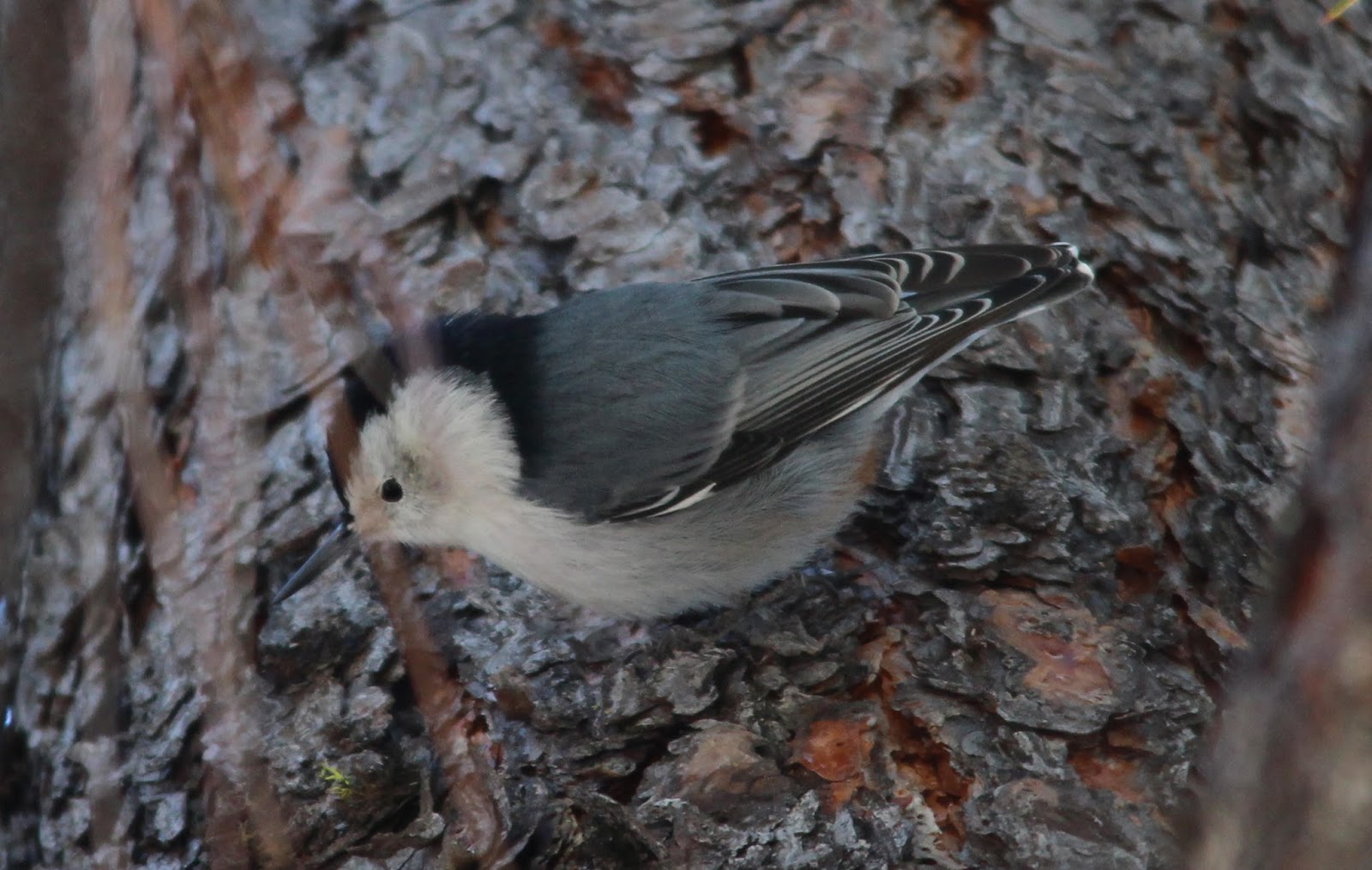
I have tried to pay more attention to the subspecies of White-breasted Nuthatch. These were all chattering with a rapid call.  A feature of the tenuissima subspecies (lumped with nelsoni in Sibley's  Interior West bird), the subspecies which should be found in Eastern Oregon. 


Interior West birds have narrower black crowns than the Pacific group,  and they lack a black mark behind the eye which can sometimes be found on the Pacific group.


Compared to the Pacific group the Interior West birds have darker but not black centers to the greater coverts, they are shown here as the dark dashes on the gray background.  The Pacific group supposedly has paler, less contrasting centers on the greater coverts.


The flanks are supposedly darker gray, rarely suffused with buff, the Pacific birds are paler on the flanks and can be suffused with buff.


Taken with my iphone, most of the hike was on bare ground or patchy snow.  This dark canyon is where Tygh Creek crosses FR 27. It was 2 pm, the area was still dark and cold, no winter sun reaches this area.


This is Tygh Creek down in the WMA, just as dark and cold.  I spent some time searching the grove for owls.  


This Mule Deer ( I think)  was on FR 27, it was a beautiful beast, it just stood there and watched me walk towards it. Black-tailed Deer are subspecies of the Mule Deer.  Mule Deer are larger and have big mule-like ears. They also have a larger white rump and a smaller black tipped tail compared to smaller white rumped and larger, solid black (dorsal surface) tail on the Black-tailed.   Black-tailed Deer are a western Oregon species but I understand they do occur on eastside of Mt Hood.


This print in the snow was the size of my hand.  Tons of animal tracks were seen, of all sizes and shapes.


Gobble gobble

Mt Hood glowing in the late afternoon sun.


eBird list:

White River WMA Loop, Wasco, Oregon, US
Nov 28, 2015 9:15 AM - 1:15 PM
Protocol: Traveling
7.0 mile(s)
Comments:     temps 14-22 degrees F, no wind clear skies.  Went to see if any Pine Grosbeak or Redpolls had shown up in area.  No juncos.
16 species

Wild Turkey  1
Red-tailed Hawk  2
Williamson's Sapsucker  1
Hairy Woodpecker  5
Black-backed Woodpecker  1
Northern Flicker  4
Steller's Jay  8
Common Raven  4
Mountain Chickadee  23
Chestnut-backed Chickadee  14
Red-breasted Nuthatch  6
White-breasted Nuthatch  6
Pacific Wren  4
Golden-crowned Kinglet  30
Varied Thrush  5
Red Crossbill  9


Thanks for the visit

Saturday, November 14, 2015

Sandy River Winter Passerines


On Wednesday and then again today (11/14/15) Huck and  I went out to hunt through my favorite patch of winter passerine habitat in the Portland area.  It is a patch of weeds, trees, and blackberries along the Columbia River at the Sandy River Delta.

Here is a map I created a few years ago for the area. A link is available on the Birding Oregon web site under Multnomah County, Sandy River Delta.

The area I like for winter passerines is the orange rectangle on the east side of meadows.

If you go to the Sandy River, be sure to go all the way out to the east side.


 I spotted a nice Merlin flying over the open meadows.


From a distance, Merlin might be confused with Sharp-shinned Hawks, but note the long wings coming down almost to the tail. Simply noting the short wings of an accipiter will eliminate most other raptors.


They have been redesigning the wetlands out on the east side of the delta.  They also planted trees in some areas.  This ditch was enlarged to provide better drainage.


This is the upriver end of my passerine hunt, I walk back down through this brush on an old trail, heading down river to the observation deck area.  I cut out to the river across from Gary Island where I can to check for ducks and if any birds are in the willows.

This little ditch was packed with Song Sparrows, Lincoln Sparrows, Dark-eyed Juncos and Golden-crowned Sparrows.


It is easy to pish out a few Fox Sparrows, actually I do not pish them I give a little click like their contact call and that brings them right out to the top of the brush.


A small flock of Lesser Goldfinch were in the area. I had some flyover American as well.


A noisy flock of Pine Siskins were feasting on the same seeds as the goldfinch.


First-winter White-crowned Sparrow (pugetensis)


Lots of Golden-crowned in area.


Hairy Woodpecker


Red-winged  Blackbird


Very tough getting a shot of a Golden-crowned Kinglet out in the open.


This is the Red-tailed Hawk  that posed for Sibley's book cover.


I'll find a good bird along this area sometime soon.

Birds seen on Wednesday:

Cackling Goose  15
Canada Goose  5
Mallard  3
Hooded Merganser  3
Double-crested Cormorant  3
Great Blue Heron  1
Greater Yellowlegs  2
gull sp.  25     seen on bar far out in river, probably mix of Cals and Mews
Belted Kingfisher  2
Downy Woodpecker  1
Northern Flicker  2
Merlin  1
Black-capped Chickadee  6
Chestnut-backed Chickadee  3
Bushtit  8
White-breasted Nuthatch  2
Pacific Wren  2
Golden-crowned Kinglet  5
Ruby-crowned Kinglet  3
Varied Thrush  1
European Starling  1000
Fox Sparrow  5
Dark-eyed Junco  25
White-crowned Sparrow  8
Golden-crowned Sparrow  8
Savannah Sparrow  2
Song Sparrow  9
Lincoln's Sparrow  3
Spotted Towhee  4
Red-winged Blackbird  3
Western Meadowlark  20
House Finch  7


Birds seen on Saturday:

Cackling/Canada Goose  30
Green-winged Teal  3
Pied-billed Grebe  1
Horned Grebe  2
Double-crested Cormorant  50
Great Blue Heron  4
Great Egret  1
Red-tailed Hawk  1
American Coot  1
California Gull  3
Belted Kingfisher  2
Downy Woodpecker  3
Hairy Woodpecker  1
Northern Flicker  2

Merlin 1
Black-capped Chickadee  30
Chestnut-backed Chickadee  5
Bushtit  25
White-breasted Nuthatch  3
Brown Creeper  10
Pacific Wren  3
Golden-crowned Kinglet  14
Ruby-crowned Kinglet  7
Varied Thrush  2
European Starling  25
Fox Sparrow  4
Dark-eyed Junco  35
White-crowned Sparrow  5
Golden-crowned Sparrow  29
Song Sparrow  20
Lincoln's Sparrow  5
Spotted Towhee  7
Red-winged Blackbird  4
House Finch  6
Pine Siskin  40
Lesser Goldfinch  20


Thanks for visiting and Vive la France.


Wednesday, April 1, 2015

Olallie Meadows

I went to Olallie Meadows Saturday afternoon in the hopes of finding owls Saturday night.  I had never been to the far eastern part of Marion County.  I was very glad I went.  From Portland you drive out past Estacada and then down FR 46.  From Salem go out to Detroit Lake and hang a left onto FR 46 just as you enter Detroit.


arrived at the Olallie Meadows Campground, got out of the car, and heard a very familiar two part call.  Pine Grosbeak.


It was an overcast afternoon, so it was hard to make out exact colors on the bird. I had to lighten up the photo just to see the details. Other grosbeaks in the area this winter look like montanus, they lack red down the flanks. The other option is the coastal form flammula.  This one appeared to be flammula. They have more color down the flanks.  I hear Pine Grosbeak in the Cascades during the summer.  They usually are deep in the forest and high in the trees, so getting a view of them is hard.  I think the locals are more common in the Cascades than we think.  I am going to make an effort to find more breeding Pine Grosbeaks this summer.  

Olallie Meadow.  Lots of frogs.


Birds seen at meadow:

Red-breasted Sapsucker  1
Northern Flicker  3
Chestnut-backed Chickadee  6
Red-breasted Nuthatch  4
Dark-eyed Junco  5
Pine Grosbeak  1     Calling from top of tree


My trip got off to a great start with the grosbeak.  I decided to hike north on the Pacific Crest Trail.  My goal was Lemiti Meadow (orange star on map).  I was thinking it might be an open meadow where I could spot some owls later in afternoon.  There are numerous small lakes in the area along the trail. This is Jude Lake. 


There were four Barrow's Goldeneye on the lake.  There is something special about seeing these ducks in their summer haunts.


Two typical views of the trail.


Lemiti Meadows turned out to be a set of bogs full of water surrounded by thick forest,  It was past 4 pm by the time I got there, and I had 5.5 miles to get back to my car before dark, so I did not spend as much time there as I had hoped.

Birds seen along trail:

Mallard  2
Barrow's Goldeneye  4
Sooty Grouse  3
Northern Pygmy-Owl  2
Northern Flicker  3
Common Raven  2
Chestnut-backed Chickadee  28
Red-breasted Nuthatch  31
Golden-crowned Kinglet  23
American Robin  4
Varied Thrush  3
Song Sparrow  1
Dark-eyed Junco  17


After I got back to the car I noticed this sign:


Not sure what they meant by hazards.  Or was it a passive agressive way to keep folks from using their campground?  I decided to be safe and sleep in the car, thus avoiding the hassle of setting up my tent.  I took off looking for owls once it got dark.  

The bright moon was nice to owl by.  I stuck with the car and stopped every half mile.  I played a Boreal Owl sound with my iphone just once then listened.  The recording was not very loud but I thought it was loud enough.  Only owls I heard were a Great Horned and a Saw-whet.  


Olallie Butte at dusk.


I spent the night in the car with the window cracked open in case I heard an owl.  I thought I heard a few toots, but only when I was half-asleep. I woke up a few times but heard nothing for sure.  Next thing I knew it was 7 am and the sun was up. 

Birds:

Great Horned Owl  1
Northern Saw-whet Owl  1

In the morning I hiked down south on the PCT to a power line then cut over to FR 4220 and walked back to the campground.

A huge Hairy Woodpecker, without a black bar splitting the red. I would like to figure out the subspecies on these birds. 


There were lots of sapsuckers in area.  They were all too far off the trail to see.  The calls were of Red-breasted or Red-naped. not sure which.  I assumed Red-breasted.

One of the many open areas you see along the trail.


Part of the trouble with the trails early in the season is all the blow down from the winter. It can take some effort to get around these obstacles.


Triangle Lake.


Birds seen:

Mallard  2
Red-breasted Sapsucker  3
Hairy Woodpecker  1
Steller's Jay  3
Common Raven  2
Mountain Chickadee  2
Chestnut-backed Chickadee  13
Red-breasted Nuthatch  15
American Robin  4
Varied Thrush  3
Yellow-rumped Warbler  1
Dark-eyed Junco  20
Red-winged Blackbird  2
Red Crossbill  5


Lemiti Creek, where it crosses FR 4680 on the way back to Portland. FR 4680 seems like a nice stretch of road to bird.  I saw a Mountain Quail along the roadside.


Olallie Meadow is 87 miles from my SW Portland house, which puts it closer than some spots on the east side of Hood.  I will be back here. A few of us are trying to organize a group effort.  There is a large butte nearby with a road to the top, looks good for owls.  The trees seem a bit larger than the area I owled on the 28th to 29th.  I am hoping that improves my results.