Showing posts with label Great Blue Heron. Show all posts

Sunday, January 24, 2016

Sundial Island at the Sandy River


I have been trying to get to Sundial Island all winter to do a bird survey, the weather finally cooperated today the 24th of January.

For some more information I posted last week about this area and some excerpts from Lewis and Clark's journals try this :  Sandy River

I started off from Camas at 8:15, it is a quick 20 minute paddle across the Columbia. Huck agreed to go along as bow ballast.  The keen observer will note I am paddling the canoe backwards.  A trick when paddling alone is to do just that. It places you closer to the center of the boat, helpful in wind and current.

I hope to visit this island two times per season.  I was disappointed in the number of birds seen, perhaps a slow day.  I wonder if the winds that are common this far up the river keep bird numbers down. There are however lots of great habitat spots. I found only one flock of juncos.  Juncos were a bird I was expecting to see in larger numbers.  I also expected to find some Savannah Sparrows. 


A look upriver from Camas.


And downriver as well.  Lewis and Clark saw huge numbers of geese, swan and ducks here.


The island looked much like it did when it was connected to the mainland.  Except the trails are gradually being overgrown, a few of the marginal trails I once hiked are all but gone.


A Bald Eagle was enjoying an overlook of the Sandy River.


The eagle decided I was not a threat.


A Great Blue Heron relaxing along the restored eastern fork of the Sandy River created an eerie scene.


American Robins were singing away.


There are still good numbers of woodpeckers out there, Hairy Woodpeckers were common.


After a 5.25 mile loop I was happy to find my canoe.  It is not that close to the water, it is sitting up on a bank.


This is my map of the whole delta, it is available on the ECAS web site under Multnomah County, Sandy River.


My bird list:


Sundial  Island, Multnomah, Oregon, US
Jan 24, 2016 8:40 AM - 1:40 PM
Protocol: Traveling
5.25 mile(s)
Comments:     overcast, one very slight and brief rain shower for maybe 10 min, some sun, no wind, high 40's temp.
28 species (+1 other taxa)

Bufflehead  3
Common Goldeneye  1
Common Merganser  1
Double-crested Cormorant  3
Great Blue Heron  3
Bald Eagle  3
Red-tailed Hawk  3
California Gull  1
Western x Glaucous-winged Gull (hybrid)  1
Anna's Hummingbird  1
Belted Kingfisher  3
Downy Woodpecker  4
Hairy Woodpecker  8
Northern Flicker  5
Pileated Woodpecker  1
American Crow  3
Black-capped Chickadee  35
Bushtit  50
Brown Creeper  3
Pacific Wren  3
Bewick's Wren  2
Golden-crowned Kinglet  20
Ruby-crowned Kinglet  6
American Robin  6
European Starling  7
Dark-eyed Junco  12
Golden-crowned Sparrow  5
Song Sparrow  7
Spotted Towhee  4

Thanks for visiting!


Sunday, December 13, 2015

Walk on the Beach: Red-legged Kittiwake


I was eager to get out of town and do some birding after an eternity of heavy storms and a tree falling on my house (all okay).  I was hoping for a window to get down to Corvallis and explore the EE Wilson WMA and look for some longspurs south of there.  However I was also thinking of hitting the coast to see the stormy seas.  I decided on the coast after I saw a gap in the weather at 10 am today, Sunday the 13th, and a low tide. Also a challenge was thrown down by a coastal birder to get out and to see what could be found along the beaches.  Clatsop County was being well covered today by the Seaside/Astoria gang, the fine folks in Tillamook currently have their beachfront a few miles inland of where I usually go.   So that left my second favorite beach town on this planet (next to Barnegat Light), Newport, Oregon.  

I arrived right at 10 am as the rain let up.

I tried to go out onto the South Jetty but the gate was locked.   I decided to go to South Beach State Park and to attempt to walk the beach north back up to  the South Jetty.   It would be a short walk , but good enough with the tide rising on a log-strewn beach under storm conditions.

When I got to the beach, I saw a group of birders up north.  I knew they were looking for a Mountain Plover that has been on beach for a number of days.  They found it before I got to them.  Good thing, I would have walked right by it as they had when they first looked for the bird.


The decline in the population of Mountain Plover has been dramatic.  Or has it?  I always wonder about politics and scientific reports at government agencies.  Do they bounce species on and off watch lists at a whim or is it real science.   Based on info available at the time, O'Brien, Crossley and Karlson in The Shorebird Guide (2006) said there were less than 9,000 birds alive.  By 2011 , the Fish and Wildlife Service said there were actually 20,000 birds and that local declines did not represent overall condition of the species.

Latest info I could find.


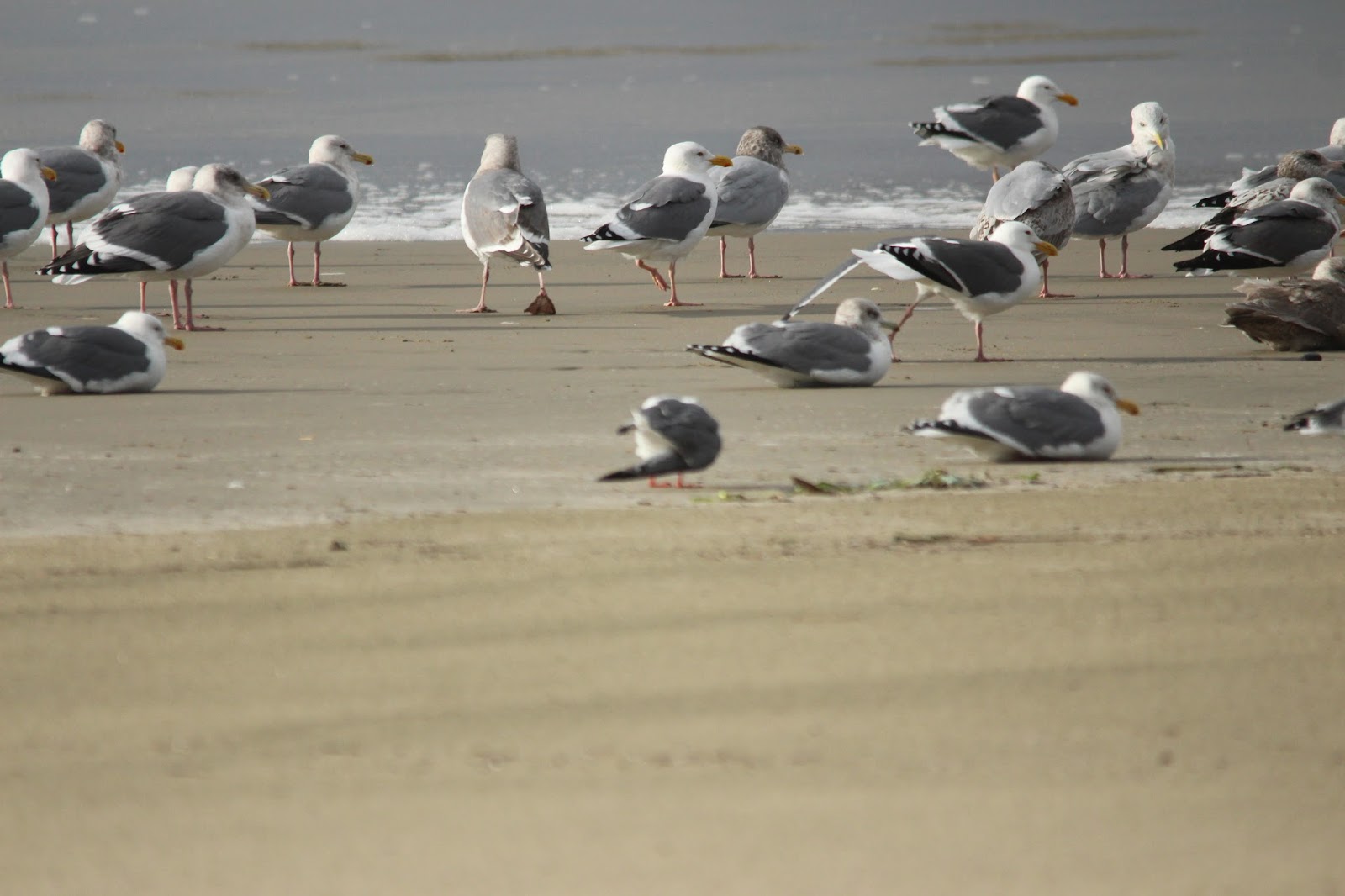
I started walking up north to the jetty, I saw a flock of gulls on the beach.  I had not noticed it yet, but note the bird sitting off to right.  It is at the bottom of a line of  gulls. From this distance ( at full zoom) I did see the Black-legged Kittiwake to the front and left of the bird.


I was studying a number of Black-legged Kittiwakes in the group. 


While I was tracking the Black-legged Kittiwake in the center, I noticed the small black-backed gull off to the right.  It also had short legs!  Short red legs to be exact..


It spent all the time cleaning itself, the wind was howling right in my face and I could see a serious squall heading my way.  But I could see the all dark primary tips on the underside of the wing and the darker back than the Black-legged, so I went quickly to a Red-legged Kittiwake.  I wanted to see a tiny pale bill but it did not cooperate. 


While I had my camera on it, it stopped once and turned its head a bit.  A tiny pale bill.


Back to cleaning it went. I was having trouble getting a perfect shot in the wind. I decided to swing-wide and move up wind of it to get a face shot before all hell broke loose with the coming squall.  I did not move in time, I was blasted by hail, I had to cover my face and get myself and my dog, Huck,  to cover.  A tidal surge, helped along by the wind blast, sent water roaring up the beach and all the gulls were gone. 

This is Oregon's 11th Red-legged Kittiwake, the third if you do not count dead and dying birds. It is the first living Red-legged Kittiwake (assuming accepted) found on land in Oregon.  The other two were off-shore sightings.  Lifer!


I have read about Red-legged Kittiwakes in case I ever found one, I knew they were darker than Black-legged Kittiwakes, but I never bothered to compare them to Western Gulls.  I thought I would be seeing a bird slightly darker than a Black-legged Kittiwake.  According to Howell's Gulls of the Americas, the Red-legged has a back that is Kodak 8.5 to 9.5, Black-legged are 6.5 to 8, Western Gulls are more variable, but from 8.0 to 9.5 for our northern subspecies.  This Red-legged was obviously the darkest gull on the beach except for a few Westerns.  Below is one of the Black-legged Kittiwakes that was sitting by the subject, taken in same light with same settings on camera.   Much paler bird.

I saw 6 Black-legged Kittiwakes in the area.


I saw 6 Snowy Plover.  I tried to capture the bands on all.  Here is what I was able to get:

Left leg: Red-Yellow-Red  Right leg: Dull yellow?


Left leg: Orange-Green  Right leg: Green


Left leg: Green-Yellow  Right leg: Dull Yellow?


This was a different bird, had a green over yellow, but never saw other leg.


Same here, could not see leg without disturbing bird, but looks like top band was purple or light blue?


The beach was littered with stressed-out-but-seeming-to-be-doing-okay  Red Phalaropes.


Nice thick-billed Red Phalarope.


.


Typical view if you go on a pelagic, minus the waves and a bouncing platform.


A number of Harlequin Ducks were hugging the jetty.  I pointed this one out to some storm watchers, much to their delight.


The tip of the north jetty.


The bar had huge breakers coming across.


The Coast Guard swept by, these beaches are dangerous as the tide comes up.  One big wave and you are in a death dance with all the moving logs.


The beach had little room for the expired.  Not many located.

Expired Cassin's Auxlet.  One seen.


Red Phalarope.  One seen.


Western Grebe.  2 seen.


I did stop by EE Wilson on the way home, just to give Huck a longer walk.  Not much activity. A heron wondered why I was out in the rain.


Thanks much for the visit.

Saturday, April 25, 2015

Clatsop County

I ventured down to the mouth of the Columbia River today to look for shorebirds.  At Wireless Road there were hundreds of Whimbrel.  I looked for birds with orange tails, and pale rumps. Looking for Bristle-thighed Curlew, none found.  I would have taken any other Asian curlew as well :).


One of the Whimbrels had enough of a Marbled Godwit.


Peace eventually won out.


Lots of Black-bellied Plover flying around.


After Wireless Road I went over to Warrenton to check out the linear path.  No mudflats were seen but a few birds were in the area.


I went out to Parking Lots C and D with little luck.  After that I drove out onto the beach at Sunset Dr.  There were thousands upon thousands of peeps on the beach.  Just about all were Western.


A great many Sanderlings were in there as well.  Each looked unique.


Took me awhile, but I finally found some Least.


The beach was also covered in Velella Velella.  They covered the sides of my car,  I needed to run it through a carwash when I got home.  Stink!


Semipalmated Plover were there in small numbers.


No rain, sunny skies and a fun day.